
The Pokémon TCG market has seen remarkable growth in recent years, with rare vintage cards and professionally graded collectibles reaching increasingly high prices. However, as the value of these cards rises, so does the incentive to produce convincing counterfeits.
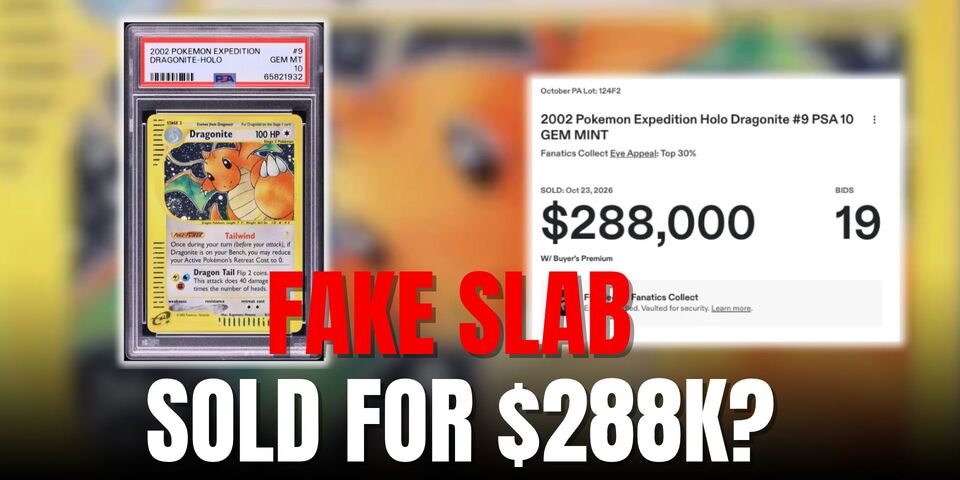
A recent controversy involving a 2002 Expedition Dragonite PSA 10, reportedly sold for $288,000 through Fanatics Collect, has brought renewed attention to the risks associated with fake PSA slabs.
The situation has raised questions about the reliability of certification numbers, the sophistication of counterfeit grading holders, and the precautions collectors should take when purchasing valuable Pokémon cards.
The $288,000 Expedition Dragonite Controversy
On October 23, 2026, a PSA 10 copy of Dragonite Holo #9 from the 2002 Pokémon Expedition Base Set reportedly sold for $288,000 through Fanatics Collect.
Shortly after the auction, a Pokémon collector on Reddit raised concerns about the card’s authenticity.
According to the collector, the auctioned Dragonite carried the exact same PSA certification number (65821932) as a card they personally submitted for grading and still own.
The collector explained that they had never sold their Dragonite, making the appearance of another card with the same certification number particularly concerning.
To support their claims, they shared photographs of their own PSA slab and screenshots from the auction listing.
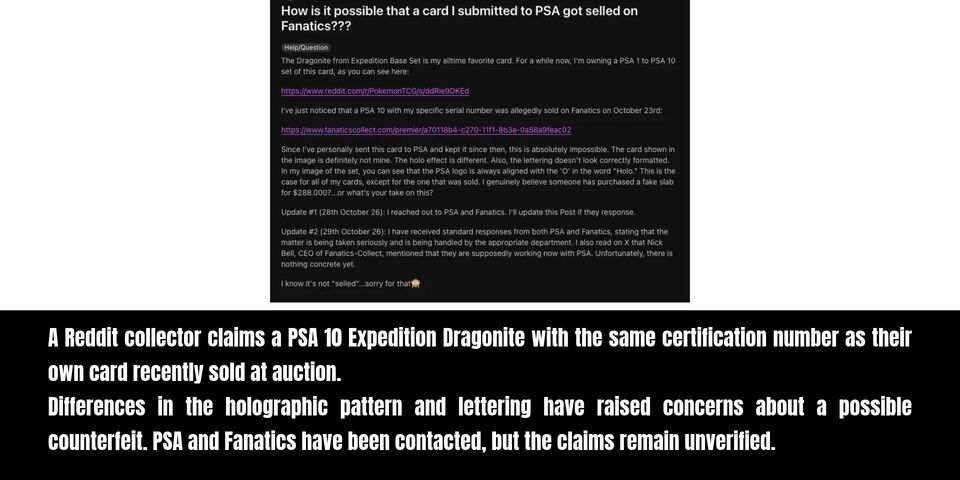
The collector also stated that they contacted both PSA and Fanatics Collect regarding the situation. According to their updates, the matter was being reviewed, although no definitive explanation had been provided.
At the time of the allegations, the authenticity concerns remained unverified, and no counterfeit had been officially confirmed.
Two Dragonite Cards, One PSA Certification Number?
One of the most concerning aspects of the controversy is the apparent visual differences between the two Dragonite cards.
Despite sharing the same PSA certification number, the collector identified differences in the cards’ holographic patterns and details on their PSA labels.
These differences have led to speculation that one of the slabs could be counterfeit.
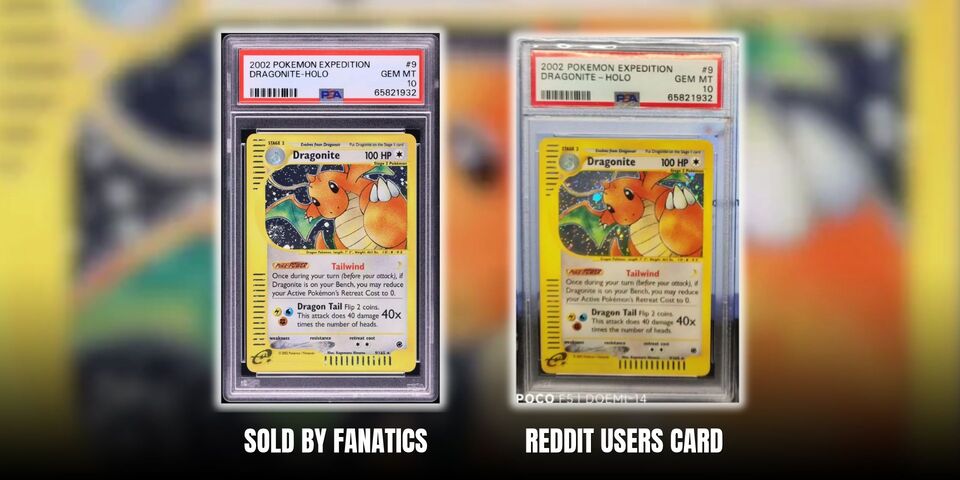
The comparison illustrates why collectors should not rely exclusively on certification numbers when authenticating expensive graded Pokémon cards.
However, differences in photographs do not automatically establish that a card is counterfeit. Lighting conditions, camera angles, image processing, and variations between PSA holder generations can affect their appearance.
Further examination by the relevant authentication companies would be necessary to determine the explanation.
Why Fake PSA Slabs Are Dangerous for Pokémon Collectors
Professional grading has become an important part of the Pokémon TCG collecting market.
Companies such as Professional Sports Authenticator (PSA) evaluate cards for authenticity and condition before encapsulating them in protective holders commonly referred to as slabs.
These holders display the card’s identification details, assigned grade, and unique certification number.
For rare Pokémon cards, a high grade can dramatically increase market value. In some cases, the difference between a PSA 9 and PSA 10 can represent thousands of dollars.
This creates a financial incentive for counterfeiters to reproduce both valuable cards and their grading holders.
Counterfeiters Can Copy Legitimate PSA Certification Numbers
One particularly concerning issue involves the duplication of genuine certification numbers.
A counterfeiter could potentially reproduce a legitimate PSA label using an existing certification number from PSA’s database.
This means that entering a certification number into PSA’s verification system may return information matching the card being offered, even if the physical slab is counterfeit.
A valid PSA certification number does not automatically guarantee that the card or holder is genuine.
This is especially important for collectors purchasing expensive vintage cards through online marketplaces, where physical inspection may not be possible before completing a transaction.
How to Spot a Fake PSA Slab
Although sophisticated counterfeits can be difficult to identify, collectors can take several precautions to reduce the risk of purchasing fake graded Pokémon cards.
1. Verify the PSA Certification Number
Every PSA-graded card receives a certification number that can be checked through PSA’s official database.
Visit PSA Certification Verification and enter the number displayed on the holder.
Confirm that the Pokémon’s name, set, card number, and assigned grade match the seller’s listing.
Remember that counterfeiters may copy legitimate certification numbers, so verification should only be the first step.
2. Compare the Card With PSA Reference Images
When PSA reference images are available, compare them carefully against the card being offered.
Pay particular attention to the following details:
- Holographic patterns and their positioning
- Card centering and border alignment
- Visible print characteristics
- Distinctive surface marks or imperfections
For holographic Pokémon cards, the positioning of certain holo features can sometimes provide useful information when comparing two photographs of an allegedly identical card.
However, differences in lighting and photography must also be considered.
3. Examine the PSA Label and Holder
PSA incorporates security features into its grading holders to make counterfeiting more difficult.
Depending on the holder generation, these features may include holographic elements, specialized label printing, QR codes, and tamper-evident construction.
Collectors should examine the label for unusual fonts, inconsistent spacing, printing defects, or suspicious security features.
It is also important to remember that PSA has updated its labels and holders over time. Differences between older and newer generations do not necessarily indicate counterfeiting.
4. Research the Seller and Previous Sales
Before purchasing an expensive graded Pokémon card, investigate the seller’s reputation and previous transaction history.
For particularly valuable cards, collectors should consider requesting additional photographs or videos of the holder and card.
Previous auction photographs can also provide useful references when checking whether a particular graded card has appeared on the market before.
If a seller is unwilling to provide reasonable verification for a high-value item, proceeding cautiously is advisable.
What Could Counterfeit PSA Slabs Mean for the Pokémon TCG Market?
The Expedition Dragonite controversy highlights a broader concern surrounding trust in the graded Pokémon card market.
Collectors frequently pay substantial premiums for professionally graded cards because they trust the authentication process and the condition assigned by the grading company.
If counterfeit slabs become increasingly convincing, buyers may face greater difficulty distinguishing genuine collectibles from fraudulent reproductions.
The potential consequences extend beyond individual financial losses.
Widespread uncertainty surrounding authentication could influence buyer confidence, marketplace practices, and demand for additional verification services.
This is particularly relevant for vintage Pokémon cards, where exceptionally high grades and limited populations can command significant premiums.
However, it is important to distinguish confirmed counterfeiting incidents from unverified allegations. The Dragonite controversy does not, by itself, establish how widespread counterfeit PSA slabs are within the market.
Professional grading remains an important part of Pokémon collecting, but collectors should understand that no authentication system is completely immune to attempted fraud.
Final Thoughts
The $288,000 Expedition Dragonite controversy serves as a reminder of the importance of careful authentication when purchasing valuable graded Pokémon cards.
While the allegations surrounding the Fanatics Collect auction remain unresolved in the information presented here, the situation demonstrates why collectors should look beyond a slab’s certification number.
Examining reference photographs, understanding PSA security features, researching sellers, and carefully comparing cards can all help reduce the risk of purchasing counterfeit collectibles.
As the Pokémon TCG market continues to grow, knowledge and careful verification remain among the most valuable tools available to collectors.
Whether collecting modern Illustration Rares, vintage holographic cards, or rare PSA 10 Pokémon cards, understanding the potential dangers of fake PSA slabs is an essential part of making informed purchasing decisions.


