
The Pokémon card market is entering one of the most remarkable periods in its history. What began as a hobby centered around collecting, trading and playing has developed into a global collectibles market attracting entrepreneurs, investors, celebrities and some extremely wealthy buyers.
This influx of money is becoming increasingly visible at the highest end of the hobby. Rare vintage cards that remained relatively stable for years are suddenly attracting much stronger demand, and certain scarce cards have doubled or even tripled in value over surprisingly short periods. New record sales can quickly change expectations for an entire category of cards.
At the same time, collectors are beginning to look beyond the obvious Base Set Charizard and famous trophy cards. Rare Japanese promos, low-population graded cards and previously overlooked releases from the 2000s are receiving more attention. Pokémon now has 30 years of history, and wealthy collectors appear increasingly willing to compete for the best pieces from that history.
The $16.5 Million Pikachu Illustrator
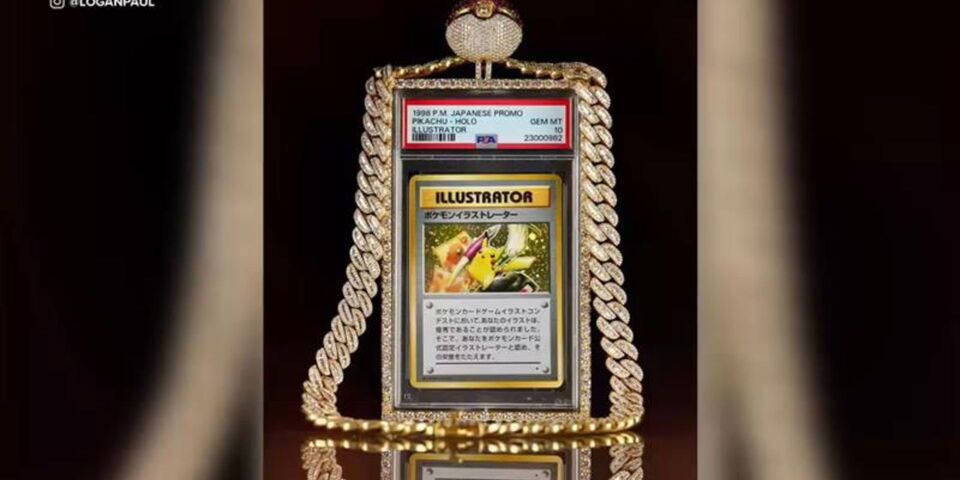
The clearest example of how much money has entered Pokémon is the Pikachu Illustrator. In February 2026, the famous Pikachu Illustrator PSA 10 previously owned by Logan Paul sold through Goldin for approximately $16.5 million, establishing a new record for a trading card sold at auction.
Pikachu Illustrator was already considered one of the most important Pokémon cards ever produced. The card was originally awarded through illustration contests in Japan during the late 1990s, and only a small number of copies are known to exist.
A Pokémon card selling for more than $16 million shows how dramatically the perception of the hobby has changed. At the highest level, Pokémon cards are now competing for the attention of collectors who also have access to markets such as fine art, luxury watches, classic cars and sports memorabilia.
A Garchomp LV.X for $900,000
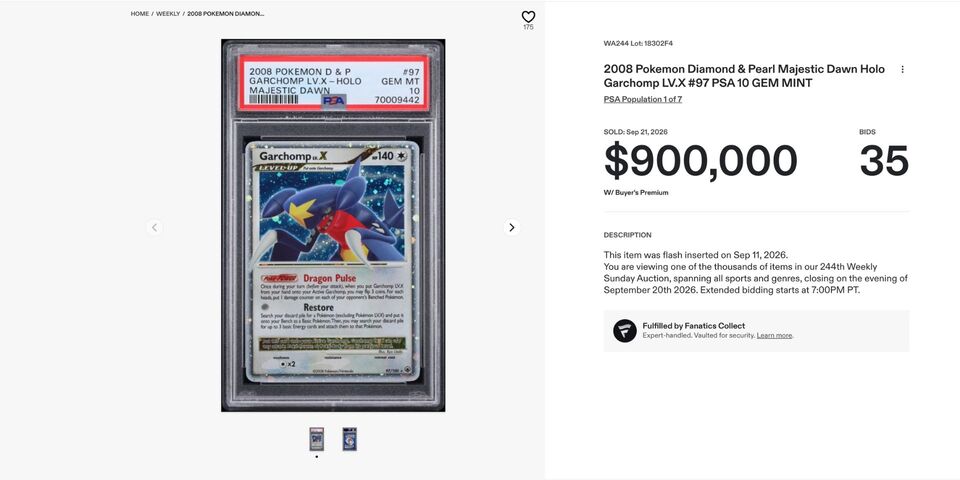
Perhaps an even more surprising example comes from a completely different generation of Pokémon. A 2008 Pokémon Diamond & Pearl – Majestic Dawn Garchomp LV.X Holo has reportedly sold for around $900,000.
What makes this particularly interesting is that Garchomp LV.X isn’t a late-1990s trophy card. It comes from the Diamond & Pearl era, a period that until relatively recently received far less attention than the earliest Pokémon releases.
This shows how collector interest is beginning to spread into later generations. Cards from Diamond & Pearl, Platinum, EX-era and other 2000s sets are approaching or exceeding 20 years of age. For collectors who grew up during these generations, these are the cards that carry the strongest nostalgia.
Vintage Pokémon Card Prices Are Moving Fast
One of the biggest developments in the current Pokémon market is the speed at which prices can change. Certain scarce vintage cards have doubled or even tripled in value over short periods, with new sales sometimes resetting market expectations from one week to the next.
This can happen particularly quickly when the available supply is extremely small. A card may have a relatively low PSA population, but the number actually available for purchase can be even lower. If most copies are locked inside long-term collections, only one or two may appear publicly for sale.
When several collectors with significant purchasing power compete for those same cards, prices can move dramatically. This has made low-population PSA 10s, Japanese promotional cards, trophy cards and difficult-to-grade vintage releases particularly interesting areas of the market.
However, this does not mean the entire vintage Pokémon market is doubling or tripling in value. The strongest movements tend to occur in specific cards where scarcity, condition, historical significance and collector demand come together.
Why Wealthy Collectors Are Entering Pokémon
Pokémon has an advantage that very few collectible markets can replicate: an enormous generation of adults who grew up with the franchise.
Pokémon launched in Japan in 1996 before becoming a worldwide phenomenon. Children who collected Pokémon cards during the late 1990s and 2000s are now adults, and some of them have significantly more purchasing power than they did even ten years ago.
For an average collector, nostalgia might mean buying back a favorite childhood card. For an extremely wealthy collector, it can mean searching for the finest known example of that card.
This becomes particularly important when the best examples are genuinely scarce. If only a handful of high-grade copies exist and several wealthy collectors want them, the amount someone is willing to pay can rise rapidly.
Scarcity Changes Everything
The Pokémon Company can print millions of new cards, but it cannot recreate historical releases. Another original Pikachu Illustrator cannot be produced. A tournament prize distributed 25 years ago cannot simply be issued again, and another original 2008 Garchomp LV.X cannot be created.
The original supply of these cards is fixed. In practice, the available supply can actually decrease as cards enter permanent collections, become damaged or simply disappear from the public market.
Condition makes this even more important. Thousands of copies of a card might theoretically exist, while only a small number have survived in a condition capable of receiving the highest professional grades.
This is why collectors increasingly look beyond the total number of cards produced. PSA population, condition, historical importance and the number of copies actually available for purchase can all influence how difficult a card is to acquire.
The 2000s Are Becoming the New Vintage
For years, “vintage Pokémon” was mainly associated with Base Set and other releases from the late 1990s and early 2000s. That definition is beginning to expand.
A Pokémon card released in 2006 is now 20 years old. Entire generations of collectors grew up with EX-era, Diamond & Pearl, Platinum and HeartGold & SoulSilver rather than Base Set.
Those collectors are now reaching an age where they can spend considerably more on the hobby. This creates another nostalgia cycle similar to what happened when collectors who grew up with the original Pokémon sets returned to the hobby as adults.
As a result, cards that were overlooked for years are being rediscovered. Rare LV.X cards, Gold Stars, Japanese promos, ex cards and other difficult-to-find releases from the 2000s are increasingly becoming important parts of serious Pokémon collections.
Japanese Pokémon Cards Remain an Important Part of the Market
Japan is especially important when discussing Pokémon history because it is where the franchise began. Many historically significant Pokémon cards were exclusively distributed in Japan through tournaments, magazines, Pokémon Center campaigns and special events.
Japan also contains entire collecting eras that remain relatively underexplored internationally. The ADV and PCG eras, for example, contain distinctive artwork, unusual promotional cards and scarce releases from an important period in Pokémon TCG history.
As collectors become more knowledgeable, historical context may become increasingly important. There is a major difference between a card that is expensive because it is currently popular and a card that is difficult to replace because of how, when and where it was originally released.
Low Population Doesn’t Automatically Mean Valuable
Population reports have become an important tool for serious Pokémon collectors, but they should never be viewed in isolation. A card having only five PSA 10 copies does not automatically make it valuable.
Scarcity needs demand.
A card can have an extremely low population simply because very few collectors care enough to submit it for grading. The strongest high-end Pokémon cards tend to combine scarcity with other characteristics such as historical significance, desirable artwork, character popularity, condition and provenance.
When all of these factors come together, the number of realistically available copies can become incredibly small. Add wealthy collectors competing for those copies and prices can move very quickly.
Does This Mean Every Vintage Pokémon Card Will Increase in Value?
No. The rapid rise of certain cards can create the impression that anything old will eventually become extremely valuable, but Pokémon is much more complicated than that.
Not every vintage card is scarce, not every PSA 10 has strong demand and a previous record sale does not guarantee that another collector will pay more in the future. Prices can fall just as quickly as they rise, particularly when speculation becomes disconnected from genuine collector demand.
Pokémon should therefore remain a collecting hobby first. Understanding the history, rarity and significance of a card is far more valuable than simply buying something because its price recently increased.
From Playground Cards to Million-Dollar Collectibles
The transformation of Pokémon over the past 30 years is extraordinary. Cards once traded between children in school playgrounds are now professionally graded, stored in vaults and sold through major international auction houses.
A Pikachu Illustrator can command approximately $16.5 million, while a Garchomp LV.X from the Diamond & Pearl generation has reportedly reached around $900,000. At the same time, certain scarce vintage cards are experiencing price increases that would have seemed almost impossible only a few years ago.
But the most important change may not be the prices themselves. It is the growing number of wealthy collectors competing for a limited supply of historically important Pokémon cards.
As this attention expands beyond the obvious trophy cards and first-generation releases, collectors are rediscovering EX-era cards, ADV and PCG releases, Diamond & Pearl, Japanese promos, low-population rarities and other overlooked parts of Pokémon history.
At Pokemastersvault, we believe understanding that history is becoming more important than ever. Prices can double, triple or fall again, but genuine scarcity, great artwork and the history behind a Pokémon card cannot simply be recreated.


